How to Fix a Broken Sleep Schedule (Without Guesswork)
If your sleep and wake times keep shifting, or you find yourself falling asleep and waking at inconsistent hours, it may indicate that your sleep system is out of rhythm.
If your sleep and wake times keep shifting, or you find yourself falling asleep and waking at inconsistent hours, it may indicate that your sleep system is out of rhythm.
This is not simply a “routine issue.”
It is often related to how your internal timing system — the circadian rhythm — is functioning.
The good news is that this system can be supported and stabilised over time, but not through random changes or guesswork.
It typically requires consistency and timing alignment.
What a “Disrupted Sleep Schedule” Actually Means
A disrupted sleep schedule is not just going to bed late or waking up late.
It can involve:
- Changing sleep times from day to day
- Inconsistent wake-up times
- A lack of stable daily rhythm
This can make it harder for the body to maintain a predictable sleep-wake pattern.
Your Body Runs on a Clock, Not Willpower
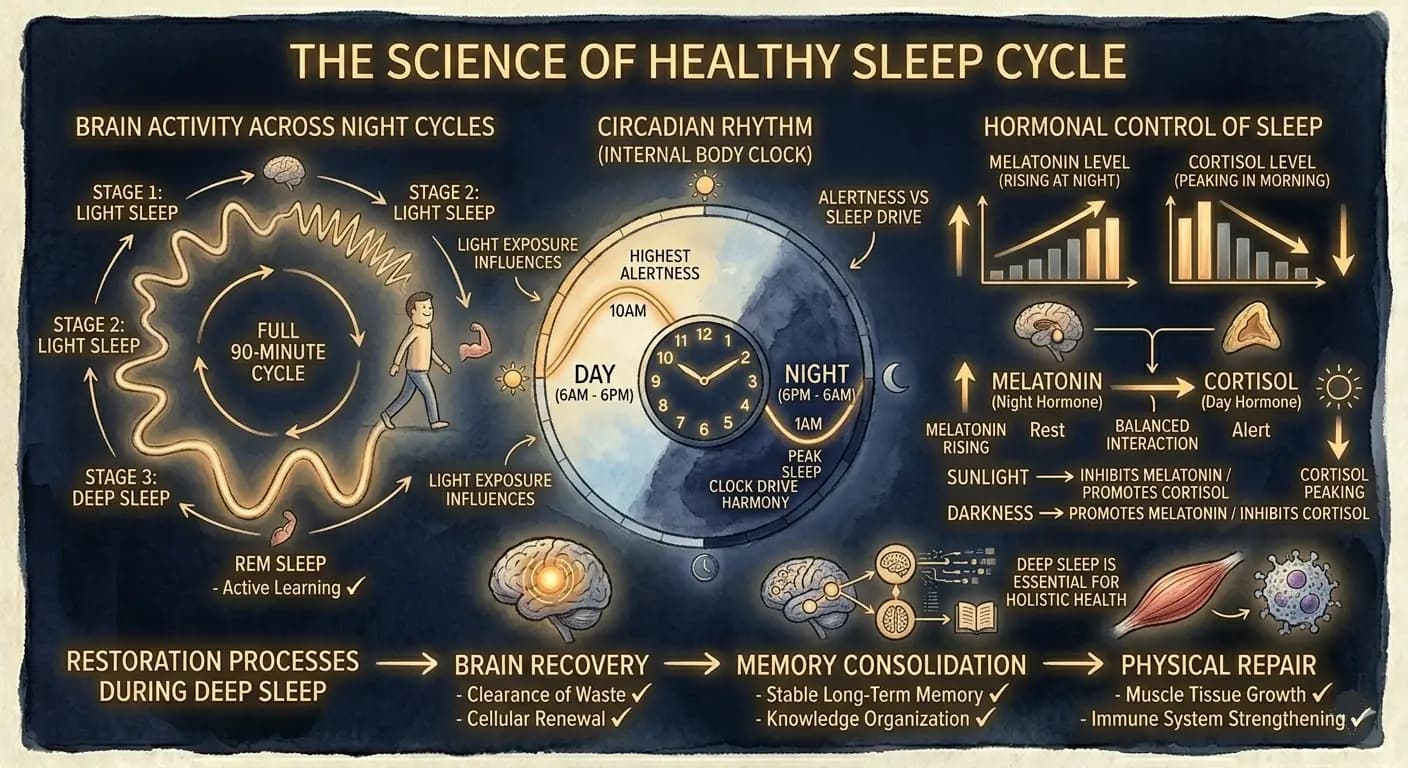
Sleep timing is influenced by an internal biological timing system called the circadian rhythm.
This system helps regulate:
- When you feel sleepy
- When you feel alert
- Hormone timing across the day
- Body temperature fluctuations
It is particularly sensitive to consistency in daily timing, especially wake time.
Why Sleep Timing Can Become Unstable
A sleep schedule may become inconsistent when:
- Bedtime changes frequently
- Wake time varies from day to day
- Evening routines shift unpredictably
- Light exposure patterns are inconsistent
Over time, the body may have less stable reference points for sleep and wake timing.
The Most Important Rule of Sleep Timing
If there is one principle that matters most, it is this:
Wake time plays a key role in anchoring your sleep rhythm.
The body often uses wake time as a reference point for setting its internal cycle.
When wake time changes frequently, the overall rhythm can become less stable.
What Happens When Your Rhythm Is Out of Sync
A disrupted sleep rhythm may be associated with:
- Difficulty falling asleep at consistent times
- Waking at different times across the week
- Feeling tired at irregular points in the day
- Reduced sleep consistency
Even if total sleep time appears adequate, timing mismatches can influence how restorative sleep feels.
Why “Catching Up on Sleep” Doesn't Fully Resolve It
Sleeping in occasionally may feel helpful in the short term, but it can also reduce rhythm consistency.
This is because it may:
- Shift the internal clock later
- Reduce consistency of wake signals
- Make timing less predictable
Sleep regulation tends to respond more strongly to consistency than to irregular recovery patterns.
The Role of Light in Sleep Timing
Light exposure is one of the strongest environmental signals for regulating the internal clock.
In the morning:
- Light signals the start of the active phase
- The body begins increasing alertness signals
At night:
- Darkness supports the transition toward rest
- Sleep-related hormones gradually increase
Inconsistent light exposure patterns may contribute to timing disruption.
Why Consistency Works Better Than Intensity
Many people try to correct sleep issues by making large changes at once.
However, the nervous system often responds more effectively to:
- Repetition
- Predictability
- Gradual adjustment
Smaller, consistent changes are often more sustainable than large, irregular efforts.
What a More Stable Sleep Rhythm May Feel Like
When sleep timing becomes more stable, people often notice:
- Easier sleep onset
- More predictable wake times
- More consistent energy during the day
- Fewer night-time disruptions
These changes typically develop gradually over time.
Common Mistakes When Trying to Improve Sleep Timing
Some approaches may unintentionally make rhythm harder to stabilise, such as:
- Frequently changing bedtime targets
- Sleeping in significantly on weekends
- Trying to force early sleep before feeling ready
- Inconsistent daily routines
These can reduce timing stability rather than improve it.
Key Insight About Sleep Timing
A disrupted sleep schedule is not typically a discipline issue.
It is more often related to timing stability in the body's internal system.
The goal is not to control sleep, but to support a more consistent rhythm over time.
Key Takeaway
Improving sleep timing is not about strict rules or perfection.
It is about restoring consistent signals so the body can gradually re-establish a stable sleep-wake rhythm.
Next Step: Understanding Your Sleep Pattern
If your sleep schedule feels inconsistent, it may be connected to a broader sleep pattern.
Understanding that pattern can help explain why timing has become unstable and what types of adjustments may be most supportive.
