Why You Feel Tired All Day (Even After Sleeping)
If you are sleeping at night but still feel tired, foggy, or low-energy during the day, it can feel confusing and frustrating.
If you are sleeping at night but still feel tired, foggy, or low-energy during the day, it can feel confusing and frustrating.
Many people assume this means they are not sleeping enough.
But in many cases, the issue is not simply sleep duration.
It may relate more to sleep recovery quality — and how effectively your system restores itself overnight.
This article explains some of the common biological factors linked to daytime fatigue, even after a full night of sleep.
The Core Issue — Sleep and Energy Are Not the Same System
Sleep is the process of recovery.
Daytime energy is one of the outcomes of how effective that recovery has been.
It is possible to meet the “time requirement” for sleep (such as 7–9 hours), but still not fully meet the recovery requirement.
This can create a mismatch between:
- Time spent asleep
- Quality of recovery achieved
Why Sleep Does Not Always Restore Energy
Sleep is made up of multiple stages:
- Light sleep
- Deep sleep
- REM sleep
Each stage supports different functions:
- Deep sleep → physical restoration processes
- REM sleep → emotional and cognitive processing
- Light sleep → transition and cycle stability
If these stages are disrupted or reduced, recovery may be less complete.
The Role of Deep Sleep in Daytime Energy
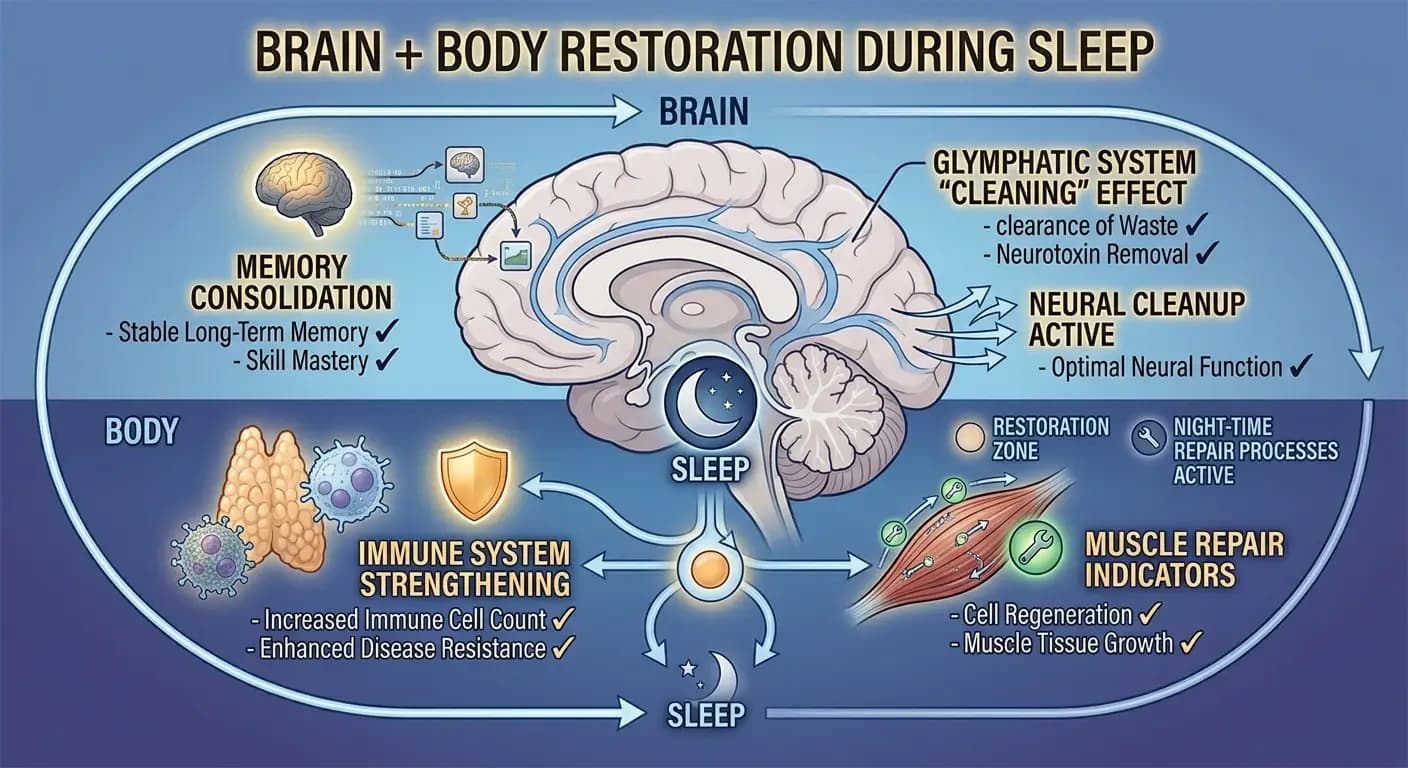
Deep sleep is strongly associated with physical restoration.
During deep sleep:
- The body carries out repair processes
- Immune function is supported
- Energy systems are replenished
- Brain maintenance processes occur
If deep sleep is reduced or fragmented, it may contribute to waking up feeling unrefreshed — even after a full night of sleep.
Fragmented Sleep and Hidden Fatigue
Even if total sleep duration appears sufficient, sleep can still be fragmented.
This may include:
- Brief awakenings during the night
- Lighter sleep dominance
- Interrupted sleep cycles
This can result in:
Sleep that is long enough in duration, but less efficient in structure.
Over time, this may reduce overall recovery quality.
The Nervous System Connection to Fatigue
Energy is not only physical — it is also influenced by nervous system activity.
If the nervous system remains partially active during sleep:
- The body may not fully downshift
- Recovery processes may be less efficient
- Sleep may feel lighter or less restorative
This can contribute to daytime fatigue, even without obvious sleep disruption.
Why You May Wake Up Feeling “Unrested”
Waking up tired may reflect incomplete overnight recovery.
Common experiences include:
- Morning brain fog
- Slower mental clarity after waking
- Low motivation or energy
- Ongoing fatigue during the day
This may suggest that sleep cycles did not fully complete restorative processes.
Sleep Debt and Accumulated Fatigue
When lower-quality sleep continues over time, fatigue may gradually build.
This is sometimes referred to as sleep debt.
However, it is not only related to missed sleep hours.
It can also involve:
- Repeated incomplete recovery cycles
- Ongoing low sleep efficiency
- Persistent nervous system load
Over time, this may contribute to ongoing daytime tiredness.
Why More Sleep Does Not Always Fix Fatigue
A common response is to try sleeping longer.
However, if sleep quality remains limited:
- The underlying pattern may remain unchanged
- Recovery cycles may still be incomplete
- Energy levels may not fully improve
This is why additional sleep does not always lead to feeling more rested.
The Hidden Role of Stress in Daytime Tiredness
Stress can influence sleep quality, which may affect daytime energy.
Even during sleep:
- The nervous system may remain more active
- Deep sleep may be reduced
- Sleep cycles may be more easily disrupted
This can contribute to waking up feeling partially fatigued.
What “Good Sleep” Often Feels Like
More restorative sleep is not defined only by duration.
It is often associated with:
- Clearer thinking in the morning
- More stable daytime energy
- Easier waking process
- Reduced mental fog
This may indicate more stable and complete sleep cycles.
Key Insight About Daytime Fatigue
Feeling tired during the day after sleeping is not always a failure of sleep itself.
More often, it suggests:
Sleep is occurring, but recovery processes may not be completing as efficiently as they could.
Key Takeaway
Daytime fatigue is not always resolved by sleeping more.
It is often more influenced by:
- Sleep quality
- Sleep cycle stability
- Nervous system activity during sleep
Next Step: Understanding Your Sleep Pattern
If this resonates with your experience, it may be connected to a broader sleep pattern type.
Understanding that pattern can help explain why recovery feels incomplete and what types of changes may be more supportive over time.
