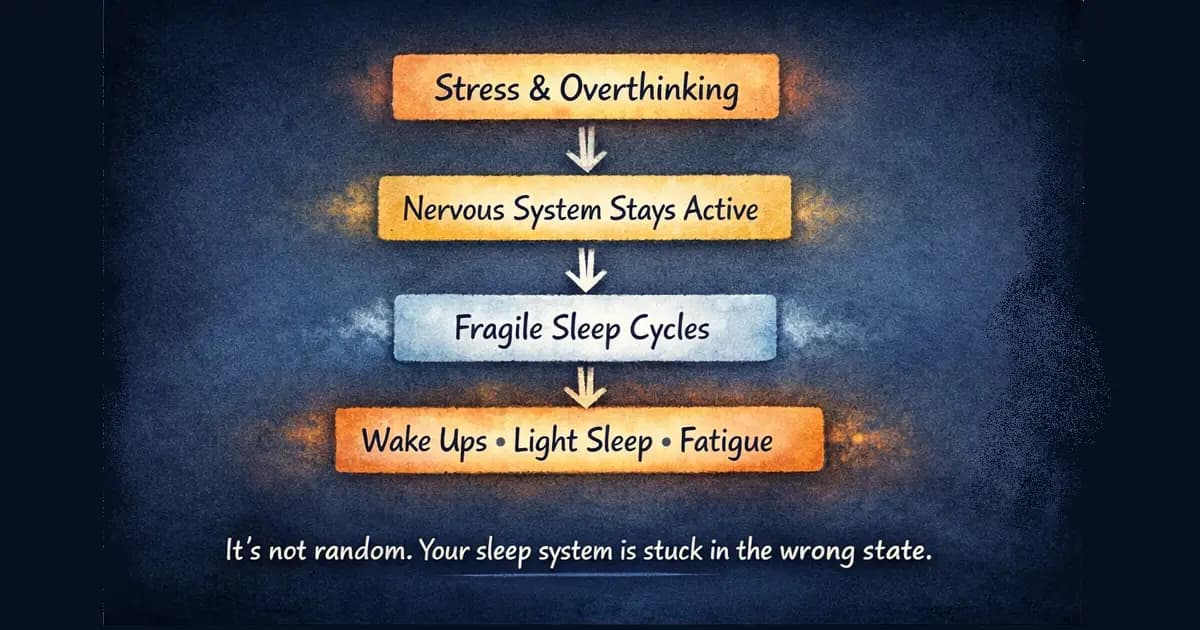
Why You Can't Fall Asleep Even When You're Exhausted
If you feel completely drained at night but still lie awake with a busy mind or a restless body, you are not alone.
If you feel completely drained at night but still lie awake with a busy mind or a restless body, you are not alone.
This experience is one of the most common sleep complaints — and one of the most misunderstood.
The key idea to understand is this:
Feeling tired and being ready for sleep are not always the same biological state.
Your body can feel exhausted while your brain is still operating in a more alert mode.
This article explains why this can happen, using simple, science-based language.
The Core Problem — Tired Body, Active Nervous System
Sleep begins in the nervous system, not just in the muscles or overall energy levels.
Even if your body feels physically tired, your brain still needs to shift into a “rest state” for sleep to begin.
This shift involves two systems:
- The stress response system (sympathetic nervous system)
- The rest and recovery system (parasympathetic nervous system)
When the stress response remains more active into the evening, falling asleep can become more difficult — even when you feel tired.
Why Your Brain Stays “On” at Night
During the day, your brain processes information, solves problems, and responds to stress.
At night, this activity is meant to gradually slow down.
However, certain factors can keep it more active:
- Unresolved thoughts or emotional load
- High mental stimulation later in the evening
- Stress carried over from the day
- Ongoing input from screens or devices
When this happens, your brain may not fully recognise that it is time to shift into a rest state.
Instead of slowing down, it can remain in a more active processing mode.
The Role of Stress Chemistry (Cortisol)
Cortisol is a natural hormone that helps regulate alertness and energy during the day.
In a typical rhythm:
- Cortisol is higher in the morning
- It gradually lowers toward the evening
For sleep to begin more easily, cortisol levels generally need to be lower at night.
Under ongoing stress, this pattern can become disrupted.
This may contribute to:
- Increased alertness at night
- Difficulty settling mentally
- The feeling of being “tired but wired”
Even when your body feels fatigued, your system may still be in a more alert state.
Why You Feel Exhausted But Can't Sleep
This creates a common mismatch:
Your body feels physically depleted, but your nervous system is still relatively active.
That mismatch can lead to the “stuck” feeling many people notice at night.
Common signs include:
- Heavy fatigue in the body
- A mind that remains active or busy
- Difficulty letting go of thoughts
- Restlessness when trying to settle
This is not simply a lack of tiredness — it is more accurately a mismatch between physical fatigue and mental state.
The “Wired Brain” Pattern
In this sleep framework, this experience is often described as a Wired Brain pattern.
This generally means:
- The mind stays active beyond typical sleep time
- Thinking continues into bedtime
- Falling asleep may take longer, even with fatigue
This is not about personality or willpower — it reflects a pattern in how the nervous system is responding.
With the right support and consistency, these patterns can improve over time.
Why Forcing Sleep Doesn't Work
A natural response to this situation is to try harder to fall asleep.
However, sleep does not respond well to effort or pressure.
Trying to force sleep can increase:
- Mental focus on not sleeping
- Frustration or tension
- Awareness of being awake
This can keep the system more alert, making it harder to settle.
Sleep tends to happen more easily when the body and mind are able to gradually downshift, rather than being pushed.
What Actually Helps (Supporting a Natural Transition)
Improving this pattern is less about quick fixes and more about supporting the body's natural transition into rest.
Helpful foundations often include:
- Reducing mental stimulation before bed
- Allowing time for the nervous system to slow down
- Keeping sleep and wake times more consistent
- Lowering environmental and cognitive load in the evening
These approaches work by supporting the conditions that make sleep more likely to occur naturally.
Key Takeaway
If you feel exhausted but can't fall asleep, it does not necessarily mean your body isn't tired enough.
More often, it suggests:
Your system has not fully shifted from a more alert state into a rest-focused state.
When that shift is supported, sleep can begin more naturally.
Next Step: Understanding Your Sleep Pattern
This experience is one of several common sleep patterns.
Understanding your own pattern can make it easier to choose approaches that fit your situation.
If you haven't already, you can use the sleep quiz to explore which pattern may be most relevant for you.
