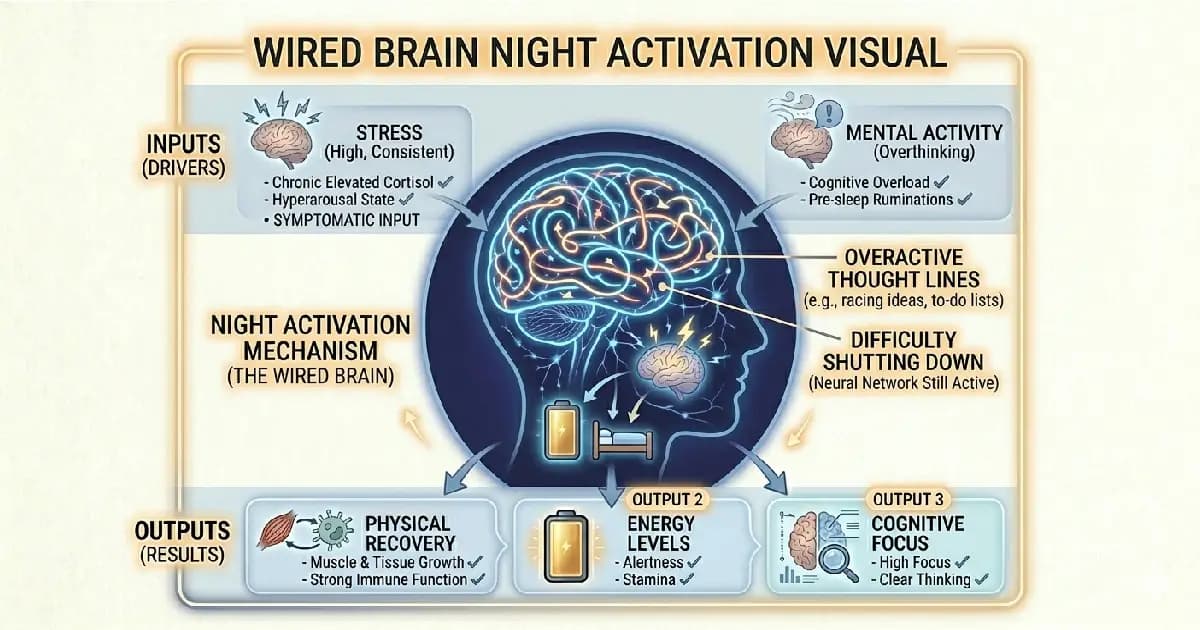
Stress and Sleep: Why Your Mind Won't Shut Off at Night
If your body feels tired but your mind becomes more active the moment you lie down, it can be a frustrating and confusing experience.
If your body feels tired but your mind becomes more active the moment you lie down, it can be a frustrating and confusing experience.
This pattern is commonly linked to how the body responds to stress — particularly how alertness and rest are regulated.
This article explains why your mind may stay active at night, and why falling asleep can feel difficult even when you are physically tired.
The Core Issue — Your Body Is Tired, But Your System Is Still Active
Sleep involves a gradual shift in the nervous system from a more alert state into a more restful one.
At times, this shift may take longer, especially after periods of stress or mental load.
This can create a mismatch:
- The body feels ready for rest
- The mind remains more active
When this happens, sleep may not begin as smoothly as expected.
What Stress Can Do to the Nervous System
Stress activates the body's natural alert system.
This response is designed for short-term situations, but it can sometimes remain active longer than needed.
When that happens, it may:
- Increase mental alertness
- Heighten emotional processing
- Delay signals associated with winding down
- Keep the brain engaged in problem-solving
In this state, the system may not fully prioritise rest yet.
Why Your Thoughts Feel Louder at Night
During the day, your attention is often directed outward:
- Work
- Conversations
- Tasks
- Movement
At night, external input decreases significantly.
As a result:
Internal thoughts can become more noticeable.
If there is ongoing stress or unresolved mental load, the brain may become more active in processing it once things become quiet.
The “Wired at Night” Feeling
A common experience linked to this pattern includes:
- Feeling mentally alert despite physical tiredness
- Difficulty slowing thoughts down
- Restlessness when trying to relax
- A sense of being “tired but awake”
This does not reflect a lack of effort or discipline.
It can simply indicate that the system has not fully transitioned into a more restful state yet.
The Role of Cortisol in Night-Time Alertness
Cortisol is a natural hormone involved in alertness and energy regulation.
In a typical daily rhythm:
- Levels are higher in the morning
- They tend to decrease toward the evening
During periods of stress, this rhythm can become less consistent.
This may contribute to:
- Feeling more alert later in the evening
- Difficulty settling mentally
- A delayed transition into sleep
Why It Can Be Difficult to “Relax” Into Sleep
Sleep is not something that can be switched on by decision alone.
It is a physiological process that depends on the body gradually shifting into a more restful state.
If the system remains more alert:
- The mind may continue processing thoughts
- The body may not fully settle
- Attempts to relax may feel ineffective
This can sometimes lead to frustration, which may increase alertness further.
Stress and Sleep Fragmentation
Even after falling asleep, stress can still influence sleep patterns.
This may include:
- Lighter or more fragmented sleep
- More frequent awakenings
- Difficulty returning to sleep
This can happen when the nervous system remains more responsive throughout the night.
Why Stress Can Feel Stronger at Night
At night:
- External distractions are reduced
- The environment becomes quieter
- Attention shifts inward
This can create more space for thoughts and emotions to surface.
The brain may use this time to process:
- Ongoing concerns
- Unresolved situations
- Incomplete mental tasks
What This Pattern Often Feels Like
People experiencing stress-related sleep disruption often describe:
- Feeling tired but unable to fall asleep
- Increased mental activity at bedtime
- Physical tension or restlessness
- Waking during the night with active thoughts
These experiences are commonly linked to a system that remains more alert than expected at night.
Key Insight About Stress and Sleep
Stress does not only affect how you think — it can influence your overall state of alertness.
It may keep your system closer to a daytime state when it is trying to transition into rest.
Why Forcing Calm Doesn't Work
Trying to force relaxation can sometimes increase awareness of being awake.
This may lead to:
- Frustration
- Increased focus on sleep difficulty
- Greater mental activity
Sleep tends to improve when the system is supported in gradually slowing down, rather than being pushed.
Key Takeaway
If your mind stays active at night, it does not mean you are doing something wrong.
More often, it suggests:
Your system may still be in a more alert state, and has not fully shifted into a rest-focused mode.
Next Step Understanding Your Sleep Pattern
Stress-related sleep patterns often overlap with broader sleep tendencies.
Understanding your pattern can help you choose approaches that better support your sleep over time.
