Why “Sleep Hygiene” Alone Doesn't Fix Insomnia
If you've tried improving your sleep by going to bed earlier, avoiding screens, or following standard “sleep hygiene” advice — but nothing really changed — you are not alone.
If you've tried improving your sleep by going to bed earlier, avoiding screens, or following standard “sleep hygiene” advice — but nothing really changed — you are not alone.
This is a common frustration in sleep improvement.
One reason for this is:
Sleep hygiene focuses mainly on external habits, not the internal sleep system.
This article explains why basic sleep advice may not be enough on its own — and what other factors may be involved.
What “Sleep Hygiene” Actually Means
Sleep hygiene refers to general habits that are commonly associated with better sleep, such as:
- Going to bed at a consistent time
- Reducing screen use before sleep
- Keeping the bedroom dark and quiet
- Limiting caffeine later in the day
These habits are not harmful.
However, on their own, they may not address all factors that influence sleep.
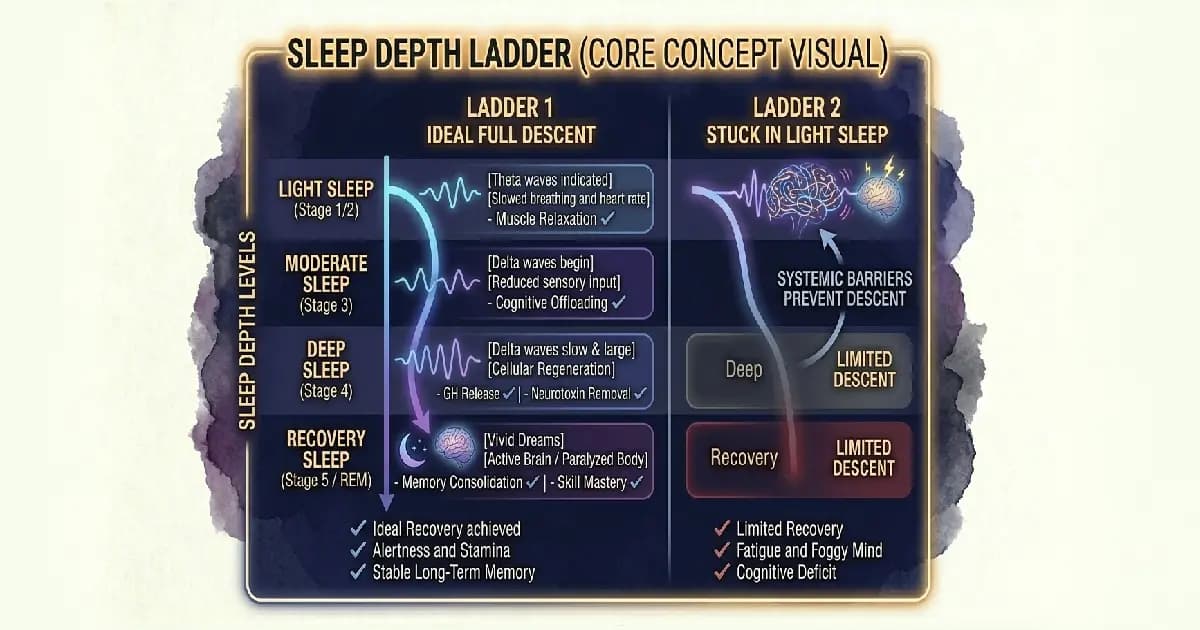
The Core Issue — Sleep Is a Biological System, Not Just a Checklist
Sleep is influenced by several internal systems, including:
- The nervous system (stress and relaxation balance)
- The circadian rhythm (internal body clock)
- Sleep cycle regulation (depth and continuity of sleep)
Sleep hygiene mainly focuses on external behaviour.
But sleep difficulties are often influenced by internal regulation as well.
Why Behaviour Changes Alone May Not Be Enough
It is possible to improve sleep-related habits without fully changing the underlying sleep system.
For example:
- Going to bed earlier may not help if the body is not ready for sleep
- Avoiding screens may have limited effect if stress levels remain elevated
- Sleeping in a controlled environment may not fully resolve internal activation
This may help explain why some people follow all recommended habits but still experience sleep difficulties.
The Missing Piece — Nervous System State
One important factor in sleep regulation is the state of the nervous system.
Sleep involves a shift from:
- More alert states (sympathetic activity)
to
- More restful states (parasympathetic activity)
If this shift is incomplete or delayed, sleep may be harder to initiate or maintain — even when external conditions are supportive.
Why You Can Do Everything “Right” and Still Struggle
Even with consistent sleep hygiene, sleep may remain difficult if:
- Stress levels are elevated
- The mind remains active at night
- The internal body clock is not fully aligned
- Sleep cycles are already disrupted
In these cases, external habits may be in place, but internal readiness for sleep may still be limited.
The Role of Circadian Rhythm Misalignment
Sleep timing is influenced by an internal circadian rhythm, not only by bedtime routines.
If this rhythm is disrupted, it may contribute to:
- Difficulty feeling sleepy at consistent times
- Early or irregular awakenings
- Variations in sleep quality across nights
In such cases, sleep hygiene alone may not fully restore consistency.
Why Insomnia May Involve Multiple Factors
Sleep difficulties are often linked to a combination of influences, such as:
- Stress-related nervous system activation
- Irregular sleep timing patterns
- Fragmented sleep cycles
- Increased sleep sensitivity
Because of this, single-solution approaches may have limited effect.
The Limit of One-Size-Fits-All Sleep Advice
Many sleep hygiene recommendations assume that:
- Sleep problems have a single cause
- Behaviour is the main factor
- One approach works for most people
In reality:
Sleep difficulties may arise from different underlying patterns that respond differently to the same advice.
Why Some People Improve and Others Don't
Some individuals may notice improvement with basic sleep hygiene changes, while others may not.
This difference may be influenced by:
- Underlying sleep pattern
- Nervous system sensitivity
- Circadian rhythm stability
- Overall stress load
Without considering these factors, results can vary widely.
What May Be More Effective Than Sleep Hygiene Alone
More comprehensive sleep improvement approaches may include:
- Nervous system regulation support
- Circadian rhythm stabilisation strategies
- Sleep cycle consistency improvements
- Environment adjustments based on sensitivity
These focus more on internal sleep regulation rather than only external habits.
Key Insight About Sleep Hygiene
Sleep hygiene is not ineffective.
However:
It may be more supportive than corrective on its own.
Key Takeaway
If sleep hygiene has not resolved sleep difficulties, it does not necessarily mean it is being applied incorrectly.
It may suggest that:
Sleep challenges are influenced by deeper biological and system-level factors that require a more targeted approach.
Final Step - Connecting Everything Together
Across different sleep experiences — difficulty falling asleep, night waking, or daytime fatigue — underlying patterns can vary.
These patterns may influence:
- Why sleep is disrupted
- How the system responds at night
- What types of changes are most supportive over time
Understanding your sleep pattern can help clarify what is actually driving the issue.
